Last Updated on October 12, 2026 by Darcy
A shared workspace can suit different working routines, but its appearance alone tells you little about how well it will meet your needs. Frequent calls, focused tasks, and client meetings each require different levels of privacy, quiet, and access to meeting rooms.
A coworking space Dallas professionals choose should fit their everyday working needs. Consider your typical workweek: how often will you visit, who else needs access, and what might interrupt your work? These questions help you assess whether a space suits your routine.
Table of Contents
| Quick Answer: To choose the right shared workspace, compare the available desks and offices, privacy for calls, meeting room access, commute, access hours, and membership terms. Tour your shortlist during the hours you would normally work. Before joining, confirm what your specific plan includes and whether the space meets your everyday needs. |
| Want to see how a workspace fits your routine? Walk through the desks, offices, and meeting areas, and ask about the plan that suits your schedule. Book a CUE tour |
A Shared Workspace That Fits Your Workday
The right shared workspace should fit your schedule and the way you work. Consider how often you’ll visit and whether you need space for yourself or your team.
The Right Plan for Occasional or Daily Use
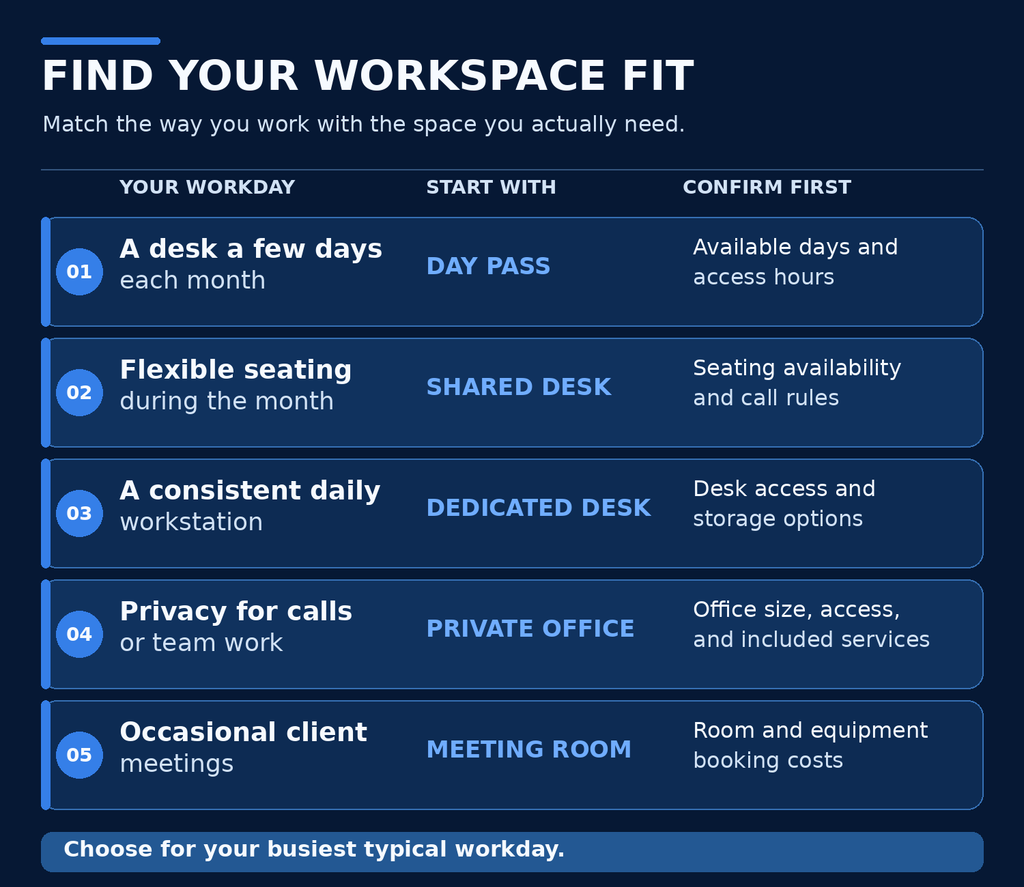
Start by estimating how often you will use the space, rather than choosing a plan based on its name. If you need a professional setting for a few workdays each month, occasional access may be enough. If you expect to come on most weekdays, consider whether a membership makes arrival, seating, and regular use easier.
Also think about why you are coming in. Someone who needs a quiet place between client appointments may have different requirements from a remote worker who wants a dependable daily routine. CUE offers day passes at its Dallas Arts District location, while its current plan information shows which options are available at each Dallas location.
Space for Solo Work and Teams
A solo professional might need little more than a comfortable workstation, dependable internet, and occasional meeting space. A team needs to consider whether people can work near one another, collaborate without disturbing others, and find privacy when discussions require it.
Think beyond your current headcount, too. If colleagues visit only on certain days, ask whether guest access or meeting room bookings will cover those visits. If the team is growing or needs a consistent base, compare private office options with the flexibility of shared seating.
Match the Workspace to Your Call and Meeting Needs
Check Whether Call Spaces Are Available During Your Work Hours
A workspace can seem quiet on a tour yet feel very different during your busiest hours. If video meetings or phone calls fill your calendar, ask where members take them, whether enclosed spaces are available, and how people handle overlapping calls.
Visit at a time when you would normally work. Notice whether calls can be taken without distracting others and whether you would have a dependable place for an unplanned conversation. This matters especially if your work involves frequent client contact or collaboration with a remote team.
Confirm Meeting Room Availability, Booking Rules, and Costs
A meeting room is useful only if you can book it when you need it. Ask how reservations work, how far ahead you can book, whether your membership includes room use, and what additional time costs. Check the room’s seating capacity, display, and video meeting setup against the meetings you host.
If you regularly meet clients, also walk through their arrival experience. Can they find the building and meeting room easily? CUE describes its conference room options for the Dallas Arts District location; member access depends on the selected plan.
Choose an Enclosed Space for Confidential Conversations
Shared desks can work well for everyday tasks, but they are less suitable for discussing contracts, finances, employee matters, or sensitive client information. Consider how often you need privacy and whether reserving a room each time would be practical.
If confidential conversations are a regular part of your work, an enclosed private office may be a better fit. During a tour, assess the space for yourself and ask how access and room bookings are handled. Do not assume that every enclosed area offers the same level of privacy.
Choosing Between Shared Desks and Private Offices
The Flexibility of Shared Seating
Shared seating can suit professionals whose schedules change from week to week. You can come in when you need a workspace without maintaining a fixed desk. It may also work well if most of your work requires a laptop and you do not need to leave materials behind.
Consider the trade-offs during a visit. Will you be comfortable choosing a different seat each time? Is there enough space for the equipment you bring? If flexible seating matches your routine, explore the shared coworking options at CUE’s Dallas Arts District location.
When a Dedicated Desk or Private Office Makes Sense
A consistent workstation can reduce daily setup time if you use the space regularly. A private office adds an enclosed area where you can work, hold conversations, and maintain a more predictable environment. These benefits may matter more as your schedule becomes busier or your team grows.
Choose based on your tasks, not just the number of days you come in. Frequent calls, equipment needs, and team discussions may justify more dedicated space even if you are not on-site every day. Ask what is currently available at your preferred location, since workspace options differ.
Shared Workspace vs Office: The Level of Control You Need
The key question in a shared workspace vs office comparison is how much control you need over your immediate surroundings. With shared seating, you gain flexibility but may not sit in the same place each visit. With a private office, you have a defined space that can better support a stable routine and conversations behind a door.
Also consider whether you want to manage an office yourself. A workspace within a coworking location may provide access to shared facilities while giving your team its own room. CUE’s guide to shared office space options explores this choice in more detail.
Choose a Location That Works Day to Day
A Commute That Works on Regular Office Days
A location that feels convenient for one meeting may be less practical several days a week. Test the trip at the time you expect to travel and consider where you go before and after work. If teammates or clients will visit, their journeys matter as well.
CUE has locations in the Dallas Arts District and North Dallas. Compare each against your usual routes rather than choosing by neighborhood alone. If you use public transit, the DART trip planner can help you check possible journeys.
Parking, Building Entry, and Guest Access
Your arrival experience becomes part of every workday. Ask where members park, whether a fee applies, how building entry works, and what visitors need to do when they arrive. If you meet clients, clear directions and a straightforward check-in process can make those visits smoother.
Confirm these details for the exact location you are considering.
Access Hours That Match Your Schedule
Check access hours before assuming that you can use the space whenever you need it. If you work early mornings, evenings, or weekends, ask whether your plan covers those hours and whether building access differs from staffed reception hours. This is particularly important if your schedule changes with client projects or teammates in other time zones. CUE notes that extended access depends on the membership and location, so ask for the terms of the plan you are considering.
Which Shared Workspace Setup Fits Your Workday?
What to Check Before Choosing a Coworking Membership
Compare What Each Plan Includes
When assessing coworking space cost, look at what the membership enables you to do each week. A plan that includes the access and facilities you rely on may offer better value than a lower-priced option that requires frequent add-ons.
Identify your essential coworking space amenities before comparing plans. These might include reliable Wi-Fi, meeting room access, printing, mail services, or refreshments. Your goal is to find an affordable coworking space that covers your real needs at a manageable total cost. CUE’s plan information provides a starting point, but confirms current inclusions for your chosen location.
Ask About Potential Additional Fees
Membership descriptions do not always answer every cost question. Ask whether parking, additional meeting room time, printing, guest visits, or business address services are included or charged separately. If you know how often you would use each service, you can estimate a more realistic monthly total.
Request the details for the specific plan you are considering. This makes comparisons more useful, especially when one workspace includes a feature that another offers only as an add-on.
Review the Terms for Changing or Ending Your Plan
Your workspace needs may change as your client work, schedule, or team changes. Before signing, check the billing cycle, required notice, and process for changing plans. Ask what happens if you need a larger office or expect to use the space less often.
Keep a copy of the agreed terms so you can refer to them later. CUE says cancellation and plan change terms depend on the selected membership.
Testing the Space Before You Commit
Wi-Fi, Seating, Noise, and Comfort
A tour shows you the layout; a working visit shows you how the space performs. If possible, spend several hours there. Connect to the Wi-Fi, join a call, sit at the kind of desk you would use, and pay attention to noise as activity changes through the day.
Check whether the chair and desk work comfortably for you, especially if you plan to stay for full workdays. OSHA’s computer workstation evaluation checklist provides useful points to consider. CUE lists a day pass for its Dallas Arts District location.
Clear Rules for Calls, Guests, and Room Bookings
Ask how members handle everyday situations: taking calls, welcoming visitors, and reserving meeting rooms. You should understand where you can work without disturbing others and what to do when plans change at short notice.
Clear rules matter most when several people share the same space. They help you predict whether the workspace will support your routine, rather than leaving you to solve basic logistics after joining.
A Side-by-Side Comparison of Your Shortlist
After each visit, write down what you observed while it is fresh. Compare the same factors for every location: commute, desk or office type, call privacy, meeting room access, hours, parking, comfort, and expected monthly total.
Then rank those factors by how often they affect your work. A meeting room you use twice a year should carry less weight than a difficult commute or a lack of space for daily calls. This simple comparison can make your final choice much clearer.
CUE’s Workspace Options in Dallas
CUE offers shared coworking access and day passes at its Dallas Arts District location, along with private office options. Its North Dallas location focuses on private office suites; day passes and flex desk memberships are not currently listed there. The right location and plan depend on how frequently you will visit, how much privacy you need, and whether others will join you. Use a tour to discuss those requirements and confirm current availability, access, and inclusions.
Conclusion
When comparing shared office space Dallas has to offer, focus on what you need from a typical workday. Your commute, call privacy, seating, access hours, and total monthly cost should guide the decision.
Visit your shortlisted spaces during your usual working hours and confirm the membership details before committing. Prioritize the factors that affect you daily, so your choice supports your current routine and leaves room for future changes.
| Ready to find a space that fits? Tell CUE how you work, how often you plan to visit, and whether you need room for calls, clients, or a team. Contact CUE to explore your options. |
FAQs About Choosing a Shared Workspace in Dallas
Is a shared workspace suitable for client meetings?
Yes, if it offers an appropriate room and straightforward guest access. Check the booking rules, equipment, capacity, and any additional charges before scheduling a meeting. You can review CUE’s conference room options for its Dallas Arts District location.
Can I try a coworking office space before committing?
Ask whether the location offers a tour, day pass, or short-term option. At CUE, you can book a tour, and day passes are listed for the Dallas Arts District location.
Can I change workspace types as my business grows?
You may be able to move to another plan or a larger office, depending on availability and membership terms. Ask how that process works before joining. CUE offers private offices and larger office options to explore.
Can I use a shared workspace address for my business?
That depends on your plan and intended use. A desk membership does not automatically include business address services. Confirm the rules for mail, registration, and public listings with the provider. CUE describes its address and mail services under its Virtual Pass.

Darcy Young is a workspace strategist at Cue Coworking Space in Dallas, specializing in flexible office solutions for freelancers, startups, and growing teams. With hands-on experience working closely with businesses, he helps identify the right workspace setups based on real operational needs, from hybrid work models to scaling teams. His insights are shaped by direct interactions with professionals navigating productivity challenges, allowing him to share practical, experience-driven perspectives on creating efficient, high-performing work environments.